Top Freight Companies in USA
Every full truckload, LTL pallet, intermodal container and overnight parcel moving across the country right now is riding on a decision someone made about which carrier to trust. That decision matters more than most shippers realize: pick well and your supply chain becomes a quiet, dependable background process; pick poorly and a single missed pickup can cascade into stockouts, chargebacks and furious customers.
This guide profiles the carriers, brokers and 3PLs that actually move the freight in the United States today, across truckload, LTL, intermodal, air, ocean and brokerage. We’ve pulled founding dates, revenue, headcount and leadership directly from SEC filings and company newsrooms rather than recycling old “top 10” lists, and we’ve flagged the recent changes — a major LTL spin-off, a couple of CEO transitions — that older articles on this topic haven’t caught up with yet.
You’ll find a complete ranked list, in-depth profiles of the eight carriers that shippers ask about most, a side-by-side comparison table, a revenue chart, a practical step-by-step guide to picking the right partner, pros and cons for the major freight modes, and answers to the questions we hear most often from people evaluating their options.

Industry Overview
Freight isn’t one industry — it’s several overlapping ones, each with its own economics. Truckload carriers haul a full trailer point-to-point. LTL carriers consolidate smaller shipments from multiple customers onto shared trailers and route them through a hub-and-spoke network. Intermodal operators hand freight off between rail and truck to cut cost on long hauls. Brokers and asset-light 3PLs own no trucks at all, instead matching shippers to a network of carriers. The mix below shows roughly how the pie splits.
| Freight Mode | Annual Revenue | Market Share |
|---|---|---|
| Trucking (TL + LTL) | $1.0 Trillion | 72% |
| 3PL / Brokerage | $249 Billion | 17% |
| Rail Freight | $88 Billion | 8% |
| Air Freight | $74 Billion | 5% |
| Ocean/Water Freight | $62 Billion | 4% |
| Pipeline | $55 Billion | 4% |
What’s changed recently: FedEx completed the spin-off of FedEx Freight into an independent public company (NYSE: FDXF) on June 1, 2026, led by CEO John A. Smith. Schneider National also transitioned to a new CEO, Jim Filter, effective July 1, 2026, with predecessor Mark Rourke moving to Executive Chairman. Both changes are reflected in the profiles below.
Complete Ranked List of Top Freight Companies in USA
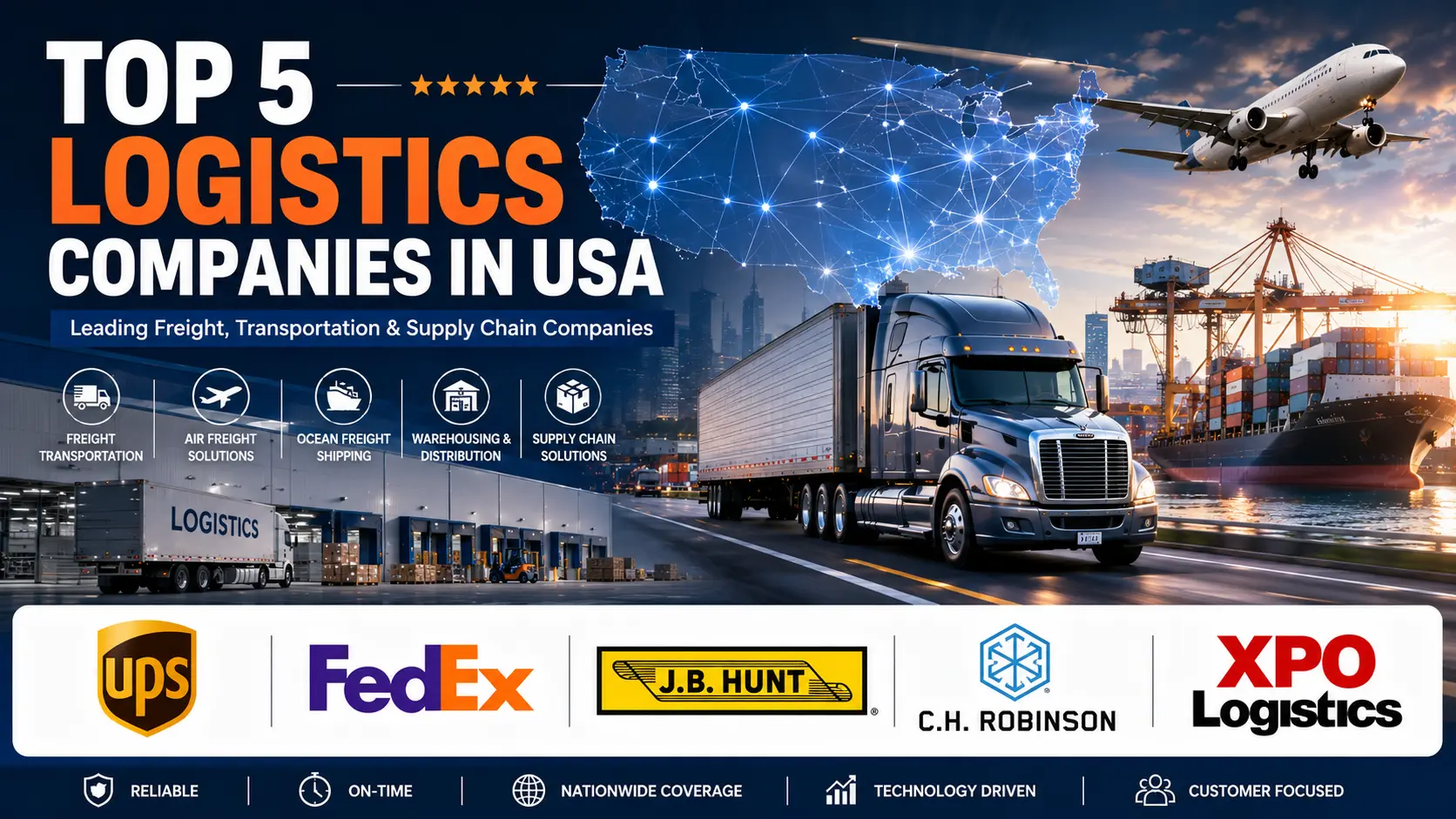
This list spans every major freight mode — truckload, LTL, intermodal, air, ocean and brokerage — ranked by a mix of revenue, network size and industry standing. Company names link to their official site so you can verify current rates, coverage and service levels directly.
Note: revenue figures are approximate and drawn from the most recent public filings or company disclosures available; several of these companies are private or subsidiaries and don’t report freight revenue separately.

Detailed Company Profiles
UPS is working through a deliberate “smart growth” strategy: shrinking its lowest-margin Amazon volume while leaning into premium segments like healthcare, SMB and B2B. CEO Carol Tomé has been candid on recent earnings calls that 2026 is a transition year, with the company targeting roughly $89.7 billion in revenue and continued network-efficiency savings. Beyond its familiar brown fleet, UPS runs one of the largest cargo airlines in the world, a full LTL division, customs brokerage, and cold-chain pharmaceutical logistics.
- Unmatched US ground network density
- Strong healthcare and cold-chain capability
- Integrated air, ground and freight brokerage
- Premium pricing versus regional carriers
- Ongoing volume decline from the Amazon glide-down
- Surcharges can be complex for smaller shippers
The biggest news at FedEx isn’t a new service — it’s a structural one. On June 1, 2026, FedEx completed the spin-off of FedEx Freight into a separately traded public company (NYSE: FDXF), led by CEO John A. Smith, with FedEx shareholders receiving one FedEx Freight share for every two FedEx shares held. What remains under FedEx Corp. is Express, Ground and the “Network 2.0” consolidated air-and-ground operation that CEO Raj Subramaniam has been building since taking over in 2022. If you’re shipping LTL freight, you’re now dealing with an independent company — see the FedEx Freight profile below.
- Fastest overnight and time-definite network in the US
- Massive automated Memphis air hub
- Network 2.0 is cutting cost and improving consistency
- LTL is now a separate company (FedEx Freight)
- Premium pricing for expedited service
- Recent leadership turnover in the CFO role
FedEx Freight is now its own publicly traded company, and it’s worth calling out separately because most freight comparisons online still describe it as a FedEx Corp. division. John A. Smith, who previously led the LTL unit from 2018 to 2021, returned as president and CEO for the separation, with veteran board member R. Brad Martin as chairman. The business carries nearly 60 years of LTL operating history and one of the strongest transit-time reputations in the industry.
- Now able to make LTL-specific capital and pricing decisions independently
- Strong historical transit-time performance
- Leadership with deep LTL-specific experience
- Loses some cross-selling ties to FedEx Express/Ground
- New public company still establishing its own credit and cost profile
- Shippers may need to re-onboard as a separate carrier relationship
XPO (the company dropped “Logistics” from its name a few years ago) is now a pure-play North American and European LTL carrier moving about 17 billion pounds of freight a year through roughly 600 service centers. It got there by spinning off two businesses that shippers still run into constantly: its contract-logistics arm became GXO Logistics in 2021, and its brokerage business became RXO in 2022. XPO’s dock automation and linehaul-routing algorithms are among the more advanced in the LTL segment, and CEO Mario Harik has kept the company narrowly focused on operational execution since the spin-offs.
- Deep investment in dock automation and routing tech
- Focused, single-segment strategy since the GXO/RXO spin-offs
- Strong North American and European LTL footprint
- Smaller network than UPS/FedEx Freight/Old Dominion
- Recent tonnage softness tied to broader freight recession
- No longer offers brokerage or contract logistics in-house
J.B. Hunt’s intermodal business traces back to a 1989 handshake between founder Johnnie Bryan Hunt and the Santa Fe Railway (now BNSF) that essentially created modern truck-rail intermodal in North America, and the company still runs the largest private container fleet on the continent. Shelley Simpson, who spent nearly 30 years at the company before becoming CEO and president in mid-2024, has continued pushing the J.B. Hunt 360 digital marketplace as the primary way shippers book and track capacity. On its Q1 2026 earnings call, Simpson described a “meaningfully different” freight environment as truckload capacity has begun tightening.
- Dominant intermodal network via BNSF partnership
- J.B. Hunt 360 gives strong real-time visibility
- Cost and emissions advantage on lanes over ~750 miles
- Intermodal transit times are slower than pure truckload
- Less advantageous on shorter or time-critical lanes
- Rail congestion can affect reliability during peak season
C.H. Robinson owns no trucks, which is exactly the point: its Navisphere platform taps a network of well over 100,000 contracted carriers to source capacity for truckload, LTL, intermodal, air and ocean freight. Dave Bozeman, who joined as CEO in 2023 after leadership roles at Ford and Amazon Transportation Services, has pushed the company further into AI-assisted pricing and quoting. That asset-light model gives C.H. Robinson unusual flexibility to flex up or down with capacity cycles — something asset-based carriers structurally can’t do as quickly.
- Enormous carrier network across every mode
- Flexible during tight-capacity markets
- Global freight forwarding alongside domestic brokerage
- Less direct control over service quality than asset-based carriers
- Margins depend on carrier market conditions
- Brokerage markup can be less transparent than direct carrier contracts
Old Dominion has built its reputation on consistently ranking at or near the top of independent LTL service surveys for on-time delivery and cargo-claims ratio, often exceeding 99% on-time performance. CEO Marty Freeman, who took over from longtime CEO Greg Gantt in 2023, has kept that quality focus front and center even through a three-year freight downcycle that pushed 2025 revenue down slightly year-over-year. Shippers moving damage-sensitive or high-value freight tend to pay a modest premium here and consider it worth it.
- Industry-leading on-time and claims performance
- Union-free, single integrated network (no interlining)
- Over 260 service centers across the continental US
- Priced at a premium versus budget LTL carriers
- Revenue has softened amid weak industrial freight demand
- Less aggressive discounting for price-sensitive shippers
The 2017 merger of Knight Transportation and Swift Transportation created the country’s largest truckload fleet, and Knight-Swift has since built out LTL (via AAA Cooper and other acquisitions) and intermodal alongside its core truckload business. Adam Miller, previously the company’s longtime CFO, became CEO in February 2024 and has been navigating a soft freight cycle — Q1 2026 results included a net loss driven by weather disruption, fuel costs and a legacy claims settlement, even as the underlying truckload business held roughly flat.
- Massive scale means capacity in nearly any lane
- Diversified across truckload, LTL and intermodal
- One of the largest driver-training pipelines in the industry
- Earnings are more cyclical/volatile than asset-light peers
- LTL network still maturing versus specialists like Old Dominion
- Scale can mean less personalized account service for small shippers
Schneider just changed hands at the top: Mark Rourke, CEO since 2019, moved into an Executive Chairman role on July 1, 2026, handing the CEO title to Jim Filter, a 27-year Schneider veteran who most recently ran the Transportation and Logistics group. The orange trucks remain one of the most recognized fleets on US highways, spanning truckload, intermodal, bulk liquid and logistics services. Schneider has also been an early adopter of autonomous-trucking pilots through partnerships with companies like Aurora, positioning it to benefit if long-haul autonomy reaches commercial scale.
- One of the most diversified service portfolios (TL, intermodal, bulk)
- Early mover on autonomous-trucking partnerships
- Long operating history and strong brand recognition
- Leadership transition adds near-term uncertainty
- Smaller intermodal footprint than J.B. Hunt
- Bulk/tank segment is a niche most shippers won’t need

Side-by-Side Comparison
| Company | Founded | Revenue | Mode | Best For |
|---|---|---|---|---|
| UPS | 1907 | ~$91B | Parcel, LTL, Air | E-commerce, healthcare, global supply chain |
| FedEx | 1971 | ~$88B | Express, Ground | Time-definite, overnight, residential delivery |
| FedEx Freight | ~1966 | ~$8.9B | LTL | Now an independent LTL carrier (FDXF) |
| XPO, Inc. | 1989 | ~$8.2B | LTL | Tech-forward LTL, mid-to-large shippers |
| J.B. Hunt | 1961 | ~$12B | Intermodal, TL | Long-haul, high-volume, cost-sensitive freight |
| C.H. Robinson | 1905 | ~$16B | Brokerage, All Modes | Flexible capacity, multi-mode, global freight |
| Old Dominion | 1934 | ~$5.5B | LTL | Premium LTL, damage-sensitive cargo |
| Knight-Swift | 2017 | ~$7.5B | Truckload, LTL | Full truckload, national coverage |
| Schneider National | 1935 | ~$5.6B | TL, Intermodal, Bulk | Diverse freight, bulk liquids, intermodal |
Revenue of the Top Freight Companies in USA
Note: UPS and FedEx revenue is dominated by parcel delivery, not pure freight. Specialists like XPO, Old Dominion and J.B. Hunt run at smaller scale but with deeper focus on a single freight mode — which is often why shippers prefer them for that specific type of freight.

How to Choose the Right Freight Company for Your Business
Know your shipment weights, dimensions, lane origins and destinations, frequency, and any special handling requirements before contacting any carrier. Precise specs get you accurate quotes and a better match.
Shipments under roughly 10,000-15,000 lbs typically move as LTL. Full loads move as truckload. Long hauls over 750 miles often cost less via intermodal. Time-critical freight moves via air. Getting the mode right is the single biggest lever on cost and transit time.
Real-time tracking, digital booking, API integration with your WMS or ERP, and automated exception alerts are now baseline expectations. A carrier that can’t provide these will create manual work and blind spots in your supply chain.
Ask for actual data on on-time delivery percentage, cargo claims ratio, and average claims resolution time. These numbers reveal a carrier’s real quality far more reliably than a sales deck.
Rates vary meaningfully across carriers for identical lanes and shipment profiles. Running a competitive RFQ annually, or at minimum every two years, keeps you from quietly overpaying relative to the market.
Important: Don’t pick a carrier on price alone. A cheaper rate paired with a poor claims ratio or inconsistent transit times will typically cost you more in damaged goods, chargebacks and operational disruption than the rate savings are worth.
Pros & Cons by Freight Mode
- Fastest transit for full loads, no handling in transit
- Simple pricing, one shipper per trailer
- Best for large, time-sensitive, or high-volume shipments
- Wasteful and costly for small shipments
- Rates swing with capacity cycles
- Driver shortages can affect availability
- Cost-efficient for shipments under ~15,000 lbs
- Wide carrier choice and service-level options
- Good network density in most major metros
- More handling touches means higher damage risk
- Slower transit than truckload on the same lane
- Accessorial fees can add up quickly
- Meaningfully lower cost on long hauls
- Lower carbon footprint than all-highway trucking
- Reduces exposure to driver capacity shortages
- Longer, less predictable transit times
- Not cost-effective under ~500-750 miles
- Vulnerable to rail congestion and ramp delays
- Access to far more capacity than one carrier alone
- Flexible during tight-capacity markets
- Single point of contact across multiple modes
- Less direct control over the carrier actually hauling your freight
- Margin sits between your rate and the carrier’s rate
- Service quality depends on the broker’s carrier vetting
Frequently Asked Questions
Sources
- UPS Q1 2026 earnings release and Q4 2025 earnings release — SEC.gov (Form 8-K filings)
- FedEx Corp. Form 10 and separation announcement for FedEx Freight, May-June 2026 — SEC.gov
- FedEx Freight Q1 FY26 financial disclosures — SEC.gov
- J.B. Hunt Q1 2026 earnings coverage — Transport Topics (ttnews.com)
- Knight-Swift Q1 2026 earnings release — SEC.gov
- Schneider National leadership transition announcement, January 2026 — SEC.gov
- C.H. Robinson board and executive appointment releases — SEC.gov
- Old Dominion Freight Line investor relations and Q2 2025 earnings coverage — Trucking Dive
- XPO, Inc. Q1-Q3 2025 results and investor fact sheet — investors.xpo.com
Figures are approximate and reflect the most recent public disclosures available as of this update. Revenue, headcount and leadership at large logistics companies change frequently — always confirm current details directly with the carrier before making a sourcing decision.